Biography
Artist’s Bio
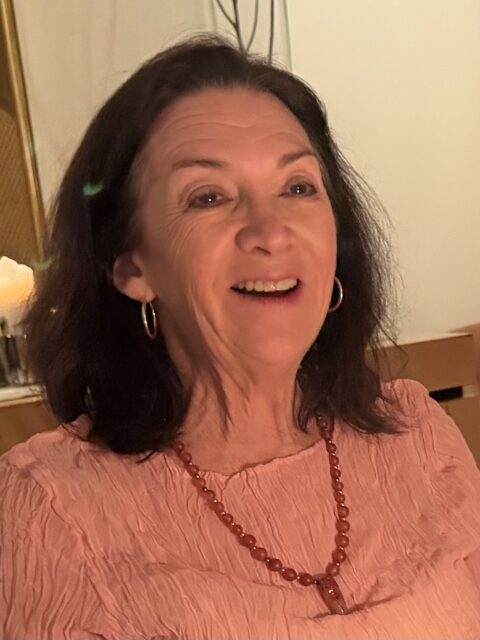
Jan Frankel Schau
Life is full of transitions. Jan Schau is a Southern California artist whose work explores memory, fracture, resilience and the quiet emotional landscapes that shape human experience. Working primarily in oil, she creates figurative and symbolic compositions that invite the viewer to discover their own narrative.
Before focusing on art, Schau spent two decades as a lawyer, later turning her attention to civil mediation. That work demands perspective taking, creativity, empathy and courage. Her years spent listening to competing truths, navigating human complexity and pathos has lead her to a deeper understanding of what lies below the surface. All of this informs Jan’s artistic vision as she focuses upon not only the black and white of the law, but the shades, the shadows, the contours and the images which are displayed in everyday scenes.
Jan is a student of Internationally acclaimed artist and founder of Z Art Academy, Zhenya Gershman, where she has developed and honed a practice grounded in classical technique, but laced with contemporary narrative and metaphor. Her paintings examine themes of transition, identity, betrayal, hope and transformation, balancing realism with evocative symbolism.
Rather than offering definitive answers, Schau intends her work creates space for reflection, inviting the viewer to indulge in a second look and a deeper understanding of the images before them. As with mediation, there is a certain kinetic and intentional ambiguity which is evoked, making space for balancing complexity with empathy, restraint with transparency, honesty with accuracy.
Schau lives and works in Los Angeles, where she continues to paint while balancing her still active mediation practice.
Artist Statement
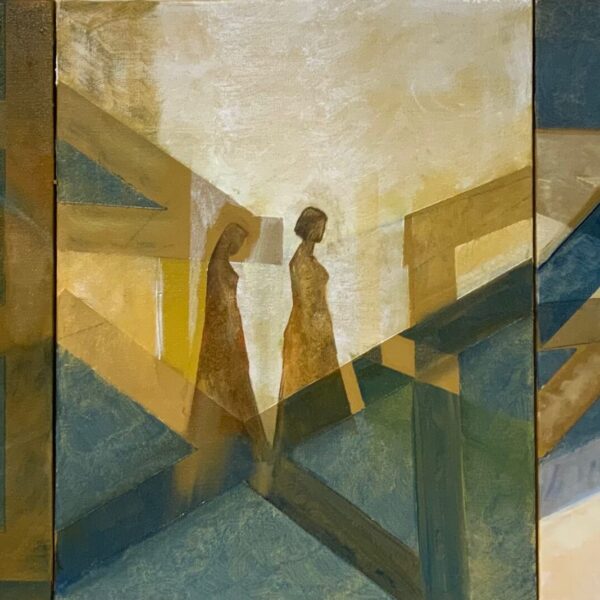
Betrayal
Oil on Canvas
Tryptich: 18” X 42 ½”Autumn is often mistaken for an ending. I see it instead as a season of revelation. As the leaves surrender their brilliance, they expose the architecture that has always been there—the branches, the spaces between, the paths we can no longer avoid.
This triptych explores that emotional landscape. Three solitary figures inhabit an abstract geometry of intersecting planes, where light and shadow fragment the familiar. They are connected, yet isolated; moving through the same terrain while experiencing different seasons of the soul.
The warm ochres and muted blues borrow from autumn’s palette—not to describe a landscape, but an interior one. Gold becomes memory, blue becomes distance, and the fractured forms suggest the invisible structures that shape our relationships: love, loss, hope, and the quiet acceptance that change is inevitable.
The barren branch reaching across the final panel is both a scar and a promise. Trees relinquish their leaves not in defeat, but in preparation for renewal. Likewise, the figures stand at that threshold where what has been must be released before something new can emerge.
Autumn reminds us that beauty is not diminished by impermanence. It is deepened by it.
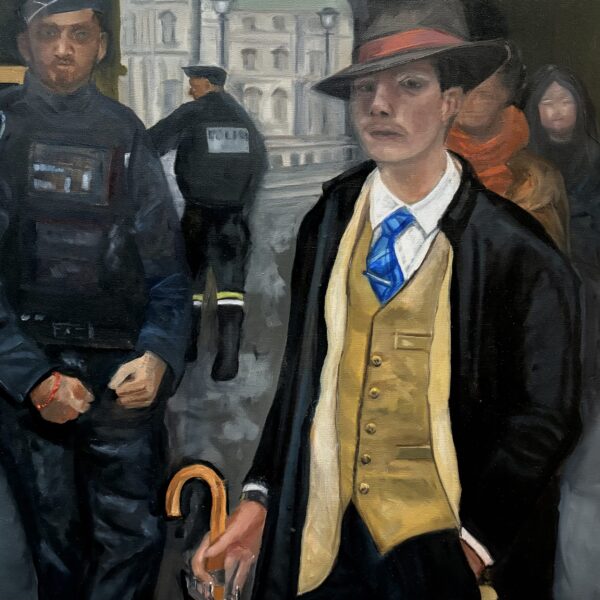
La Chimere
24” X 36”
Oil on CanvasLa Chimère was inspired by a photograph taken in the aftermath of the 2025 Louvre jewel heist, but it quickly became about far more than the event itself. As I worked, the contrasts within the scene emerged: the permanence of centuries-old stone against the fragility of modern security, the ordinary alongside the extraordinary, the deliberate order alongside wild and unexpected uncertainty.
My attention was drawn to a solitary, impeccably dressed figure whose quiet presence seemed to transcend the surrounding chaos. As I painted, subtle visual echoes revealed themselves, repeating forms, hidden rhythms, and fleeting expressions that transformed the act of observation into a dialogue between artist and subject.
La Chimère is an invitation to look beyond first impressions. It asks the viewer to linger, to return, and to discover that every moment, no matter how ordinary or chaotic, contains layers of meaning waiting to be seen.
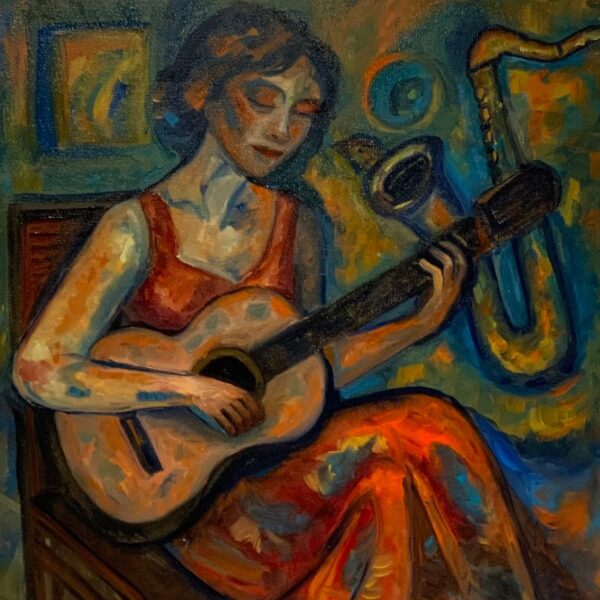
Desafinado
Oil on Canvas
20” X 20”
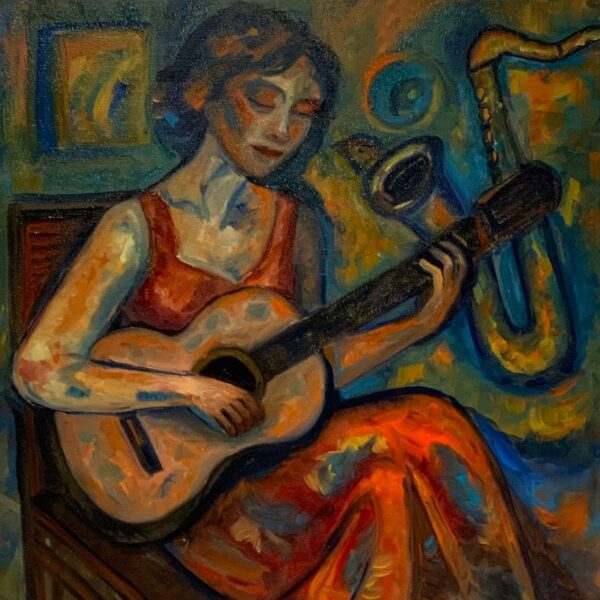
Desafinado is the title of a celebrated bossa nova composition made popular by Antonio Carlos Jobim in 1959. The name is Portuguese for “out of tune” . In the work, the artist challenges conventional ideas of harmony and dares to celebrate the subtle dissonance that gives life depth, character and undexpected beauty.
This painting explores that fragile space between balance and disruption, expectation and reality, memory, emotion and imperfect resolution. Forms emerge, dissolve and reappear, suggesting that meaning is not fixed but continually shaped by the seasons, the perspective of the viewer or listener as well as the narrator or painter.
Layered textures and shifting passages of light invite the viewer to linger awhile before reaching a conclusion about the message presented. The ambiguity is the essence, not the by-product as discordant rhythms remind us that coherence is often undiscovered and illusory.
Like the music that inspired the piece, Desafinado celebrates a stubborn resilience to synchronicity and sameness. Instead, it dares to propose that the most enduring harmonies are not born of perfection, but of authenticity—the willingness to remain open to uncertainty and to recognize beauty in the places where life falls, ever so slightly, out of tune.